
BWith a distracted president brooding in the White House, Pompeo seems to think his day has come. He seems to be pushing a personal agenda before a target audience in America, observes Ambassador M K Bhadrakumar.

Prime Minister Modi felt there were too many silos with no arrangement to take a comprehensive view on national security. The PM has entrusted NSA Ajit Doval to evolve a comprehensive roadmap and get it implemented, reveals Nitin Gokhale, Editor-in-Chief, Strategic News International.
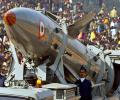
The 'Make in India' concept in the defence sector has the potential to help India meet 70 per cent of its defence needs in a few years.

The reversal of Trump's policy with regard to Iran, like the withdrawal from the Paris Agreement, may not be a matter of just turning the clock back, but one of patient negotiations, with uncertain consequences in the post-COVID-19 world, observes Ambassador T P Sreenivasan.

'The unique achievements have been made by engineers from small towns who have had a non elite upbringing and who have grown with the programme,' says R Aravamudan, one of the pioneers of the Indian space programme.
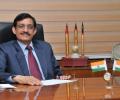
By removing Avinash Chander last week, the government has chosen to sacrifice the organisation's most potent symbol of success
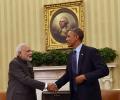
Furthering Indo-US cooperation on terrorism, Prime Minister Narendra Modi and President Barack Obama on Tuesday agreed to make "joint and concerted efforts" to dismantle safe havens for terror and criminal networks like Lashkar-e-Tayib, Jaish-e-Mohammad, Dawood-company, Al Qaeda and the Haqqani network.

The Indian Institute of Science topped the HRD ministry's 2017 national rankings. In 2016, the IISc was ranked among the world's top 15 universities in the Times Higher Education University Rankings. In his book The Creation of Wealth: The Tatas from the 19th to the 21st Century, R M Lala recounted how Jamsetji Tata's grand vision and immense personal contribution laid the edifice of arguably India's finest educational institution.

20 years ago this day, May 11, 1998, India conducted its second nuclear test at Pokharan in Rajasthan. In a fascinating interview on Rediff.com, K Subrahmanyam revealed how Indian PMs reacted to nuclear ambitions.
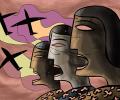
It is important to approach the belief of people in ancient India's achievements with a sense of proportion, balance and empathy, argues B S Raghavan, the distinguished civil servant.

'This was undoubtedly a premeditated strategy to thwart India's entry into the NSG.' 'If India hopes to be a major player, it must use its rising clout on the world stage to influence amenable members of the group to alter such discriminatory practices and ensure fair rules of engagement,' says Vivek Gumaste.

... and ONE man could be the reason for that, say scientists.

'India-China economic ties are likely to take a hit in the wake of the new situation, but that also provides India with a new opportunity to strengthen its manufacturing base,' points out Dr Rajaram Panda.

The agreement was reached in intensive negotiations between contact groups that Obama and Modi had set up in September.

Even as plans to redevelop Dharavi continue to gather dust in government files, its young residents have chalked their own course and chosen to fly high. Hepzi Anthony recounts a few inspiring tales.
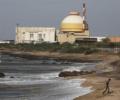
The first two units of the Kudankulam nuclear plant will discharge 6.3 billion litres of waste water every day right onto the beach. This discharge will trigger a slow-motion disaster that will poison beaches, devastate near-shore fisheries and choke the livelihood of fisherfolk in the vicinity, says Nityanand Jayaraman.
Delhi's inability to open up a new canvas with Pakistan and Sharif is symptomatic of its sluggish thinking. Jyoti Malhotra analyses

With the launch of the first indigenous aircraft today, India will join a club of nations like the United States, Russia, China, the United Kingdom and France that possess nuclear-powered submarines

This is the joint statement issued by the ministry of external affairs on the visit of US President Barack Obama to India.

The external affairs ministry's files, as distinct from those of the ministry of defence or the agencies, at least from before 1974 should be declassified. And if select files that are more than 40 years old are not to be declassified, the ministry should follow explicit guidelines to justify taking such a view, says Jaimini Bhagwat.

Science in India has developed a great deal since C V Raman, particularly after the country gained Independence but we are yet to win a Nobel prize in physics, chemistry or medicine. Is it a reflection on the quality of Indian science? Or it has to do with the politics of Nobel prizes, as is often believed, asks Dinesh C Sharma.

Patients from any part of the country will soon need to travel no more than three hours for treatment of the kind available in large metros.

'Today, three areas give banks a big headache -- steel, power, infrastructure.' 'Three Cs are very critical in lending -- character, capacity and collateral of the borrower.'

'I would like to request the AERB, UCIL and DAE to introspect. The world is changing, so is India. The wave of development and modernity will not stop for those who continue to live in the past. The future belongs to the youth who believe in the values of honesty, transparency and efficiency.'

In the third reshuffle since coming to power, Prime Minister Modi raised the strength of his Council of Ministers from 73 to 76.

Moving ahead with their new mantra -- Chalein Saath Saath: Forward Together We Go -- Prime Minister Narendra Modi and United States President Barack Obama on Tuesday vowed to deepen cooperation in every sector for the benefit of global stability and people's livelihoods over the next ten years.

Professor Chintamani Nagesa Ramachandra Rao is the third scientist to be awarded the highest civilian award -- Bharat Ratna, a crowning glory of his inexorable list of outstanding achievements.

Making nuclear exemptions for India, says Senator Edward Markey, 'only infuriates Pakistan and leads them to further increase their own nuclear capacities.'
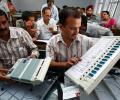
'Although the Election Commission remains convinced about the EVM's integrity, as a fair umpire of the game it was necessary to travel the last mile to convince political players that the entire process was not only fair but transparently so.' A fascinating excerpt from former Chief Election Commissioner Navin Chawla's new book, Excerpted from Every Vote Counts: The Story Of India's Elections.

In a rare move that might end the chronic impasse between arch-enemies the United States and Iran, President Barack Obama could meet his Iranian counterpart Hassan Rouhani on the sidelines of the United Nations General Assembly.

'Well begun is half done, today there are more hits than misses by the Modi government in its support towards science in India,' says Pallava Bagla.

The Mars mission is overwhelmingly irrelevant to space science and won't advance the frontiers of knowledge. It will divert attention from the real technological challenges facing the Indian space programme, and will further distort our science and technology priorities, says Praful Bidwai.

'Everybody says 5G and communication is important.' 'Everybody says automation, robotics, human computing interfaces -- people and machines working together -- is the future.' 'Everybody agrees that cybersecurity is something that is here to stay.' 'Everybody agrees that synthetic biology is important.' 'Instead of outlining thinking about industries for tomorrow and the future, let the evolutionary pathway be built in a way that it promotes robust, creative, thinking.'

Research and teaching have remained Professor Chintamani Nagesa Ramachandra Rao's first priority and first love, and that is what sets him apart, says Dinesh C Sharma

Those who know Shiv Shankar Menon will vouch that he did lots of things, substantial in the immediate neighbourhood and widespread in South Asia, but without making things public. Twenty per cent of Menon's job was visible, while 80 per cemt of his job was not known to the public, says Sheela Bhatt/Rediff.com

Take your pick. We have listed the best ones ranging from Rs 14,000 to Rs 55,000.
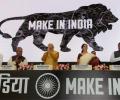
'India is going to maintain its ties to China, India is going to develop a strong relationship with the United States. It means that India is going to have the flexibility to pick and choose its friends.' 'That's traditional Indian foreign policy, and it's smart.' Former US ambassador to India Frank Wisner, one of America's sharpest minds on South Asia, tells Aziz Haniffa/Rediff.com what Washington can expect from Narendra Modi's visit.

'No PM has said no to anything we have proposed. I am not a politician and I cannot give speeches about things, but a lot of good things have been done in science by previous governments.' 'Under Dr Manmohan Singh, we could do a few important things. I used to meet him once in 6, 8 weeks. He often said, 'Professor Rao, you assume that you have my approval and carry on.' He was shy and decent. He is a real gentleman.' 'Science keeps me going at 80. I feel young.' Professor C N R Rao, the eminent scientist who was honoured with the Bharat Ratna, on the state of science in India.

These five are budget-friendly yet feature rich.

'Understand one thing, if you want immediately and magically that things should become cheap, it's not possible. It's a long-term policy.' 'Inflation is linked to the storage system and with the production system. Whenever production rises, prices go lower. So if we store when the prices are low and release them when prices rise, prices can be maintained.' 'The problem is that in our country fruits and vegetables worth Rs 110,000 crore go to waste as they rot. And grains worth Rs 85,000 crore rot. So the storage system is another big reason for inflation.' Union Transport Minister Nitin Gadkari in an exclusive interaction with Sheela Bhatt/Rediff.com
